
 |
| The Coffee House, Mayodia |
Every
time we visit the north east, there is a lot of excitement and anticipation as
to what new adventures are in store. Having been a veteran of this area, bad
roads, sudden bandhs, unseasonal rains etc are a given.
But imagine our horror
when we confronted a stretch of absent road culminating in a river bank and
were told that the beautifully marked NH37 on the map going from Dibrugarh to Roing
was actually a dirt track in large parts, including a river crossing by ferry;
jeeps and all….
 |
| Ferry across the Lohit |
The
British were the first people to “survey” the Indian subcontinent and made sure
that they made accurate maps of the terrain, culture, religion and language of
the region that they wished to administer. Of course their main interest was in
getting to know what people and resources they could exploit.
The
vast river plains of the mighty Brahmaputra that revealed great commercial
value in terms of tea and oil and even coal were called Assam. Arunachal Pradesh is the mountainous region surrounding
the river plains of Assam, left alone by the British, as having no commercial
value at all, and often inhabitated by fierce Naga tribes.

This
“Indian” state encapsulates Assam on three sides and is almost entirely claimed
by China!! Luckily for India they are
not pressing that claim too much, except in the area of West Arunachal called
Tawang, due to Dalai Lama related issues.
Notwithstanding that, as part of the
Indian Governments look east policy, a huge road building exercise is under way
in all parts of Arunachal, including the lower Dibang valley area, also called the Mahao Wildlife Sanctuary, where we
were ultimately headed.
Fortunately
for us, the colourful birds of the north east, are not aware of any man-made boundaries
or barriers and promised to be on display for us, notwithstanding the colour of
our passports.

As
with every such trip, carefully planned by NatureIndia, we intended to cover
different terrains and elevations which harbour entirely different types of
species. The backwaters of the Brahmaputra, Maguri Beel, for the ducks, the nearby
reeds for the grassland species, the lower
elevations of Roing for some typical forest species and then rising to 8000 ft
at Mayodia for the ‘rarer’ species.

 |
| Vulture Culture |
Our
group formed up at Dibrugarh airport and we set course at 1430 hrs passing Chabua
and Dinjan. A group of vultures (of three different species) perched on a
roadside tree was straight out of the movie Ice Age
We
reached the idyllic Banashree resort located on the banks of the river
adjoining the Rangagoora tea estate even as the setting sun silhouetting the
ferries, made for a travel magazine cover shot.


This
resort is run by Mr Abedin, a naturalist, and though described as ‘basic’ turned
out to be 5 star in comparison to what we were to encounter in the next six
days!!
After
a welcome cup of tea, we were treated to a documentary about the Birds of
Maguri Beel, made by him which was meant to educate the local children about
their enormous natural heritage. It was heartening to see that his son was also
following the fathers footsteps.
Suddenly
the call of the Eurasian scops owl made all the tiredness vanish and we got
spectacular views of this rather hard to spot creature. It was clarified that
the scops (or false ears) need not be visible when it is roosting. Another
higher perch was occupied by the Brown Hawk Owl whose eerie call is quite
familiar to those of us who have inhabited the Northeast for any length of
time.
 |
| Black faced Bunting |
The
morning birding in the Maguri Beel was by small boats which afforded good
closeup views of all the winged visitors from faraway places like Siberia and
Mongolia. The Northern (Chinese) spot billed duck and northern lapwing gave good
views and the rare sighting of the Baer's pochard,confirmed after the photograph was
enlarged, generated great excitement.
 |
| Boat safari in Maguri Beel |


 |
| Ruddy shelducks |
 |
| Sand martin and Barn swallow |
 |
| Chinese Spotbill ducks |
 |
| Northern Lapwing, Blackwinged stilt, Northern shoveller. |


After
a hearty breakfast, we set out for Roing on the “National Highway”. Just as we
were cruising along passing Doomdooma, suddenly the road just vanished. All manner of vehicles including cars, bikes,
jeeps and buses were seen making their own paths in the dried floodplains
leading to the river bank. After a gut-churning hour into this ordeal on a
semi-pucca road, we were relieved to be approaching the river bank. However we
were assured that an identical situation lies on the other side!!
 |
| Un necessary? |
The
Saikhowaghat is the official crossing point for anyone wishing to continue on
the highway to Sadiaghat on the other side, civilian and fauji alike.
 |
| Saikhowaghat crossing on NH 37 |
Entire
buses filled with people and fully loaded trucks were to be driven onto boats
and ferried across. The sight of the imposing 16 Km under-construction bridge
seemed to be giving a lot of solace to our tired drivers who were quite hopeful
that it would be ready by October this year.

For
now, we had to do what prehistoric Homosapiens and Polynesians have been doing for millennia. The simplicity
(crudeness if you like) of the process has to be seen to be believed. The sight
of the jeeps using 18 inch wide wooden planks to hop on and hop off the boats
brought our hearts into our mouths.
Even as we marveled at this phenomenon,
one of the planks cracked and our vehicle almost went into the river. But I
guess this was not a first for the people there, as they nonchalantly got
together and heaved the vehicle up the sand bank to safety. Of course the
driver Gogoi, sitting inside was not amused at all and had to summon his best
driving skills, ex-military experience and steely nerve to avert disaster.


Now
that we had crossed over and were famished, we dined at the local specialty
restaurant along the river bank. For us vegetarians there was rice and aloo,
while the others feasted on the local fish. Suddenly we realised the importance
of small niceties like spoons and napkins when in the field, something for
which only Clara was most appropriately kitted.


 |
| Who says its a spectacle case |

After
another hour of bouncy driving on a semi road-like track, we reached the border
town of Roing and stopped for the Inner line permit formalities. A road from
Itanagar in the west and Tezu in the east was seen to be converging here.
Before long we were driving on a metaled road and things seemed so much better.
We
stopped for tea and supplies at the main Bazaar which seemed rather well
stocked, considering that all supplies had come the same way that we had!!
Three cheers to the Banias and Marwaris.


 |
| Mishmi Hill Camp, Roing |
As
we reached the Mishmi Hill camp at Roing, the power went off and lo and behold, a
spectacular display of the crystal clear night sky came on. Raja became our
astronomy guide and we could actually see star clusters inside the sword of
Orion with birding binoculars!! Ameya Ketkar spotted many a satellite scurrying
across the sky, while Jupiter was literally glowing like a LED lamp.
 |
| NH 37 in the Deopani river crossing |
The
Mishmi Camp is set adjoining the Deopani river, the flowing water of
which, provides the background music for camp inhabitants. The mountain streams
are tapped for the perennial water supply and for a change I didn’t mind the sound of the overflowing overhead tank or feel guilty
flushing the toilet repeatedly !!
After we settled in our rooms (we got the
tents which were quite comfortable except that there were common loos) we
joined the huddle in the common room for ‘revision’ and dinner.


The
location for the early morning birding was the nearby Sally lake which was
approached by a ‘road’ passing through the Deopani river. The area did not
yield as much as expected, but the shrill cries of a nearby group of Hollock
Gibbons got everyone excited though they did not come into view.

After breakfast we set course towards Mayodia and noticed that the hill road managed by the defence organization (Border Roads or GREF) was in the process of being four-laned. While that would be music to the ears of people living uphill and beyond, the associated destruction of the bird habitat was a cause of concern for us.
Anyhow, much short of the curiously named ‘Tiwari Gaon’, the road construction
ended. However the laying of the brightly coloured OFC along the hill road
seemed to be going all the way up.

Along
the way there was fabulously preserved and pristine secondary forests which
played host to several dazzlingly spectacular species of birds.


 |
| Himalayan water |
 |
| Fern shoots for sabzi |
In
this part of the world, Mother Nature seems to provide everything that one
needs to survive including sparkling mineral water and fern-shoots for making
sabzi!! For us city people venturing so far away from civilization there was
packed lunch served hot on the bonnet of the jeep!!

As
we climbed up, the chill started setting in and a hot cup of tea at Tiwari Gaon
was most welcome. This Gaon is nothing but a cluster of huts, and a camp of the
BRO…and also a regular sighting place for the black-throated prinia.


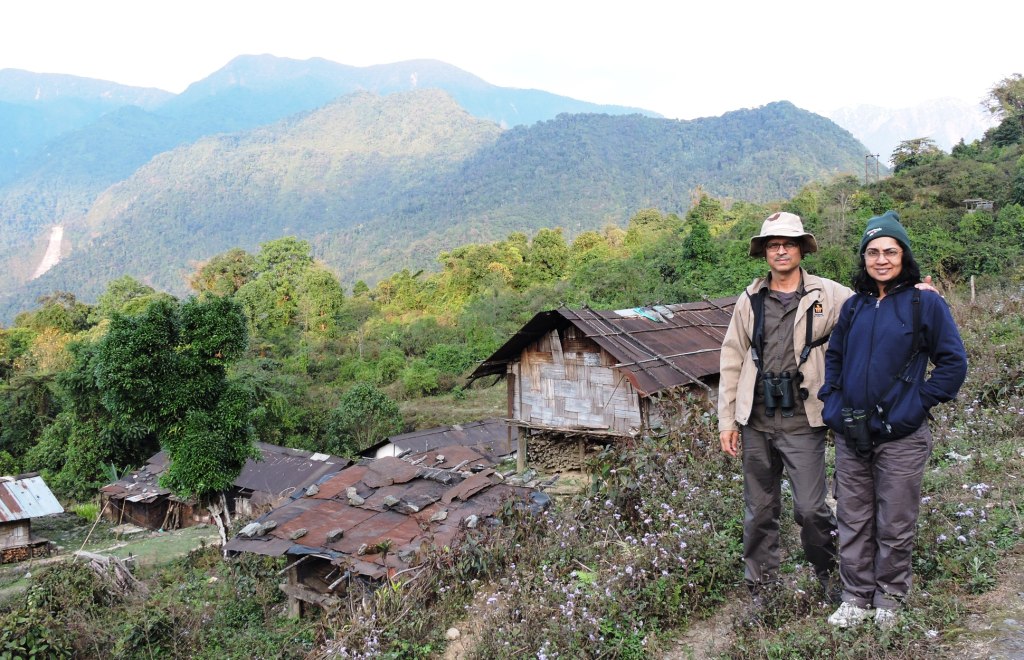 |
| Tiwari Gaon |
It
was dark by the time we pulled into the “Coffee House” camp at Mayodia. This
camp has nothing to do with Coffee, but the story goes that when the road was
being built, the BRO had made a temporary structure where staff would have food
(and probably coffee) and it was named so, knowing their quirky sense of humour
which is often on display on the road signs.
The camp was bought over and
developed by a local gentlemen called Robi who was our host for the next three
nights.

 |
| Coffee House-Upper level |
Thankfully
it is a proper cement structure with several paradoxically well appointed rooms,
though devoid of power supply. We were pleasantly surprised to check into a
huge room with a double bed and massive razais and a proper bathroom with
Jaquar fittings!! It’s just that it was too frightfully cold to put the hand in
water….let alone any other body parts. We instantly realized why we would be
having our next bath only after 4 days!!
 |
| Yellow billed blue magpie |
The
dining area next to our room, had a battery powered LED lamp and was to be our
huddle place in the evenings, which were long and well utilized. There were energetic
gupshup and nok-jhonk sessions punctuated by Raja challenging Clara on many of
her bird sightings while she gracefully helped him with birds that he had
forgotten to tick.
Of course there were serious revision sessions and many a
birding pearls of wisdom delivered by Adesh and Mandar. The best parts were the
seemingly inexhaustible namkeens brought out by Ameya and Rujuta. We were told
that we had been extremely lucky with the weather, as only last week the entire
area was under a thick blanket of snow!!
 |
| Black faced laughingthrush |
Even
so, trying to go to sleep was quite an exercise with one having put on multiple
layers, gloves and caps, but still not managing to keep out the cold
adequately. I felt that my fingers and toes had gone missing. Just think of our
soldiers manning the Glacier…..
The
food served here was fantastic, considering the logistics involved. The tea was
there at 0515 sharp! The hearty breakfast served on the balcony with the view
of the snow capped peaks was something else.
The kitchen waste from the camp served to attract many local rarities as we got ‘studio’ views of the yellow-billed blue magpie, black-faced laughingthrush and streaked scimitar babbler among others.
 |
| White tailed nuthatch |
 |
| Fire tailed sunbird |
 |
| Streak-throated barwing |
 |
| Stripe throated yuhina |
 |
| White-browed rosefinch |

As we halted at the Mayodia Pass, the white-browed rosefinch and the streak-throated barwing were on spectacular display. There is a Signals Dett of the army right on the pass.
The enthusiasm of this motley crew of four men ‘incarcerated’ at
this inhospitable and lonely location had to be seen to be believed. Before we
knew, hot steaming cups of tea were being served by a Havaldar to complete
strangers. Long live the spirit of Indian Army!!.

 |
| Mayodia Pass |

This
is also the place where one gets a weak BSNL signal ever so briefly, for those
who wish to connect with the outside world. I wondered why anyone would want to
do that though.
We
descended down to 62 (yes that’s the name of a place since they are named as
per the Km from Roing) which is on way to Hunli and Anini. We had some of the most fruitful sessions in
this area on both days.


The
lunch served at the Fooding Place consisting of good ol Maggi, was hot and
invigorating. The notable sightings included the black faced warbler,
bar winged wrenbabbler, beautiful sibia, beautiful nuthatch, treecreeper, fulvettas (Nepal
and Manipur), maroon backed accentor.
 |
| Beautiful sibia |
 |
| Maroon backed accentor |

On
the way back we stopped at Tiwarigaon and ran into a group of very excited
photographers from Mumbai. Apparently they had sighted a kind of bunting which has not been recorded here before.
En route there was an excellent sighting of the crested goshawk.
As evening drew close and as we thought that it was the end of the days birding, they pulled out a rabbit from the hat. There was a deserted camp just short of Roing where the Hodgsons frogmouth had been reported. Much excitement followed as we trooped in pitch dark and waited patiently for more than half an hour. Finally a pair showed up and we got excellent sightings thanks to some very powerful FBI style torches.
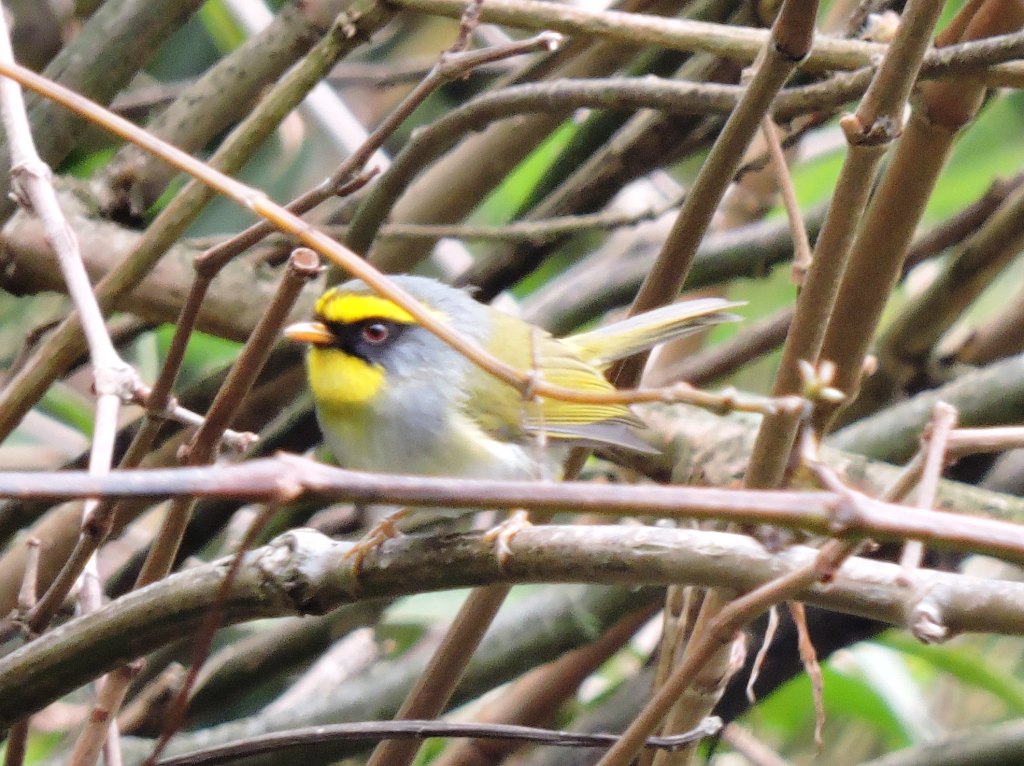 |
| Black faced warbler |
As evening drew close and as we thought that it was the end of the days birding, they pulled out a rabbit from the hat. There was a deserted camp just short of Roing where the Hodgsons frogmouth had been reported. Much excitement followed as we trooped in pitch dark and waited patiently for more than half an hour. Finally a pair showed up and we got excellent sightings thanks to some very powerful FBI style torches.
 |
| Hodgsons frogmouth |

We
thawed out at the Mishmi camp at Roing, and the next morning were back at the
Sally lake. This time there were fabulous sightings including the rufous-necked
laughingthrush and black backed forktail at the riverside. The spectacular
display by the ruby cheeked sunbird in brilliant sunlight defies description. The
sights from atop the viewpoint overlooking the river were simply out of the
world.
Notable sightings included the chestnut thrush, silver eared mesia and rufous gorgeted flycatcher. We even stalked and got a fleeting glimpse of the ultra shy bird called red-faced liocichla.
 |
| Ruby cheeked sunbird |
 |
| Himalayan bluetail |
Notable sightings included the chestnut thrush, silver eared mesia and rufous gorgeted flycatcher. We even stalked and got a fleeting glimpse of the ultra shy bird called red-faced liocichla.

 |
| Chestnut thrush |
As we made our way back along the dreaded river crossing (this time uneventful) we managed to spot the himalayan bluetail, dusky warbler and the firebreasted flowerpecker.
Returning
back to the Banashree camp was most looked forward to, in view of the piping hot water that was
provided for a bath and for the excellent hospitality. The next morning was the
last item on the agenda in the form of the Magori grassland.
Crossing the small rivulet by boat, we were transported to an entirely different and unique habitat. There were rewarding views of the yellow bellied warbler and the rufous capped babbler. Again there was much excitement since the first sighting of White browed crake in India had been made here yesterday, though we were no obliged with a sighting.
 |
| Maguri grassland |
Crossing the small rivulet by boat, we were transported to an entirely different and unique habitat. There were rewarding views of the yellow bellied warbler and the rufous capped babbler. Again there was much excitement since the first sighting of White browed crake in India had been made here yesterday, though we were no obliged with a sighting.
The bluethroats, Siberian
stonechats and tricoloured shrikes were seen in good numbers though the
Siberian rubythroat eluded us. That still did not deter our overall birdlist
from crossing 150 including many lifers.
 |
| Tricoloured shrike |
 |
| Siberian stonechat |
Having
visited west Arunachal (Eaglenest/Nameri) comparisons were bound to arise with
this area of Arunachal. While both trips are enjoyable in their own right, this
one scores in terms of infrastructure and comfort (relative), while the Nameri
component definitely scores over Maguri. We leave it to our hosts to check out
the Walong and Lekhapani-Jairampur valleys for subsequent sojourns…One just
can’t have enough of Arunachal it seems.

Travelers:
DJ,
Sangeeta, Rajagopal and eight others.
Travel
dates: 28 Feb to 06 March 2016
Camera:
Nikon P 600 on auto mode.
Tour
organizers: Nature India
Travel
Tips:
Dibrugarh
airport has a thoughtfully placed ample waiting area after the arrival and
luggage pickup, which is air conditioned, and has adequate toilets and a snack
bar.
Much
of the credit for our smooth ride on the trip goes to our chief driver Bobby
Singh who is an Assamese Sardar!!
 |
| Bobby Singh and his crew |
The
Banashree resort is recommended even for a one night getaway from Mohanbari /
Chabua/ Dinjan for those who are so inclined.
Distances
in the hills of North east should not be measured in terms of kilometres but in hours.


